
Buchanan County Court Records After Arrest
Court records after a Buchanan County jail arrest are built through Iowa's state court process, not through the jail alone. The county inmate-search page sends readers to Iowa Courts Electronic Docket Record Search for the most recent court information. That referral is important because a booking charge can be preliminary. Law enforcement may forward reports, statements, photos, videos, and evidence to the County Attorney, and the prosecutor performs an independent review before deciding whether and how a case proceeds.
The Buchanan County Attorney is Shawn M. Harden. The County Attorney is the chief prosecuting attorney for state-law violations that occur in Buchanan County and county ordinance violations. City ordinance cases are handled by the city attorney for the city involved. The office does not investigate crimes, complaints, or child abuse, and it does not represent private people. For custody status or booking details, use Buchanan County jail inmate records. For booking photos, use the Buchanan County jail mugshots page.
Find Court Records After Arrest
Iowa Courts Online is the public portal for Iowa state court dockets. The Judicial Branch describes the docket as an index of filings and proceedings in state court cases, maintained by clerk of court offices statewide. Public docket access is free and does not require registration or a subscription. Public case documents are different. Those documents are viewed at a public access terminal in the courthouse in the county where the case was filed.
- Open Iowa Courts Online and choose Trial Court Case Search from the public search options.
- Use Name Search if the defendant name is known, and set County to Buchanan.
- Set Case Type to Criminal or Traffic for most arrest-related cases, or use All if the case type is uncertain.
- Use Citation Number Search for tickets or citations, or Case ID Search when a case number appears on a jail, court, or citation document.
- Open the case result and read the charge list, docket events, court dates, bond entries, warrants, orders, and disposition fields as available.
The search index can lag. Iowa Courts research notes that public trial search results cover cases entered into ICIS through the end of the last business day, while a selected case can show up-to-the-minute case data as entered by the Clerk. That timing helps explain why a recent jail arrest may not appear in a public court search right away.
The Iowa Courts Online screenshot shows the public docket portal that Buchanan County directs people to for current court information.
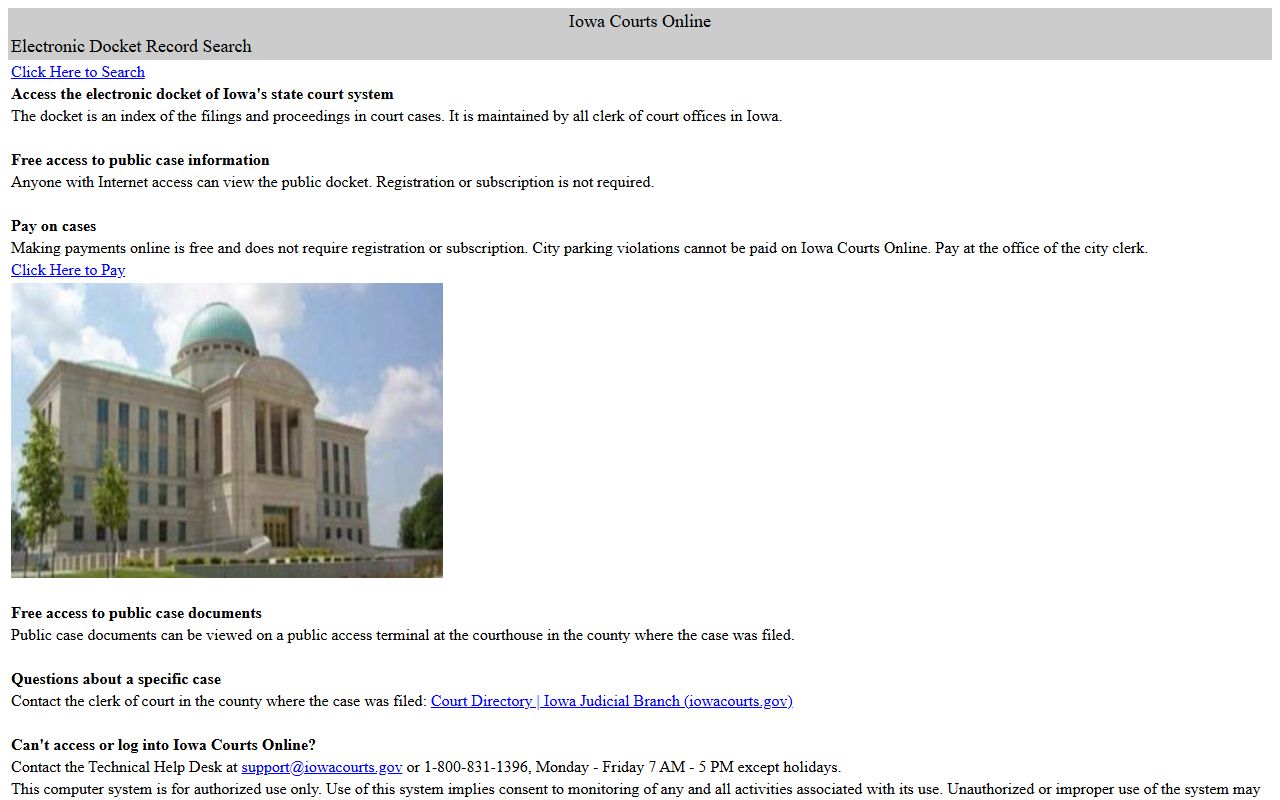
The court portal is the key source for the filed case, while the jail page remains a custody source.
Buchanan County Court Search Fields
The Iowa Courts trial search gives several paths for finding court records after a jail arrest in Buchanan County. A name search works when the defendant's name is known. Case ID search works when a case number appears on a court notice or jail-related document. Citation Number Search is useful for traffic or citation matters. Advanced Case Search and Schedule Search require registration, so the public search is the best first path for ordinary access.
| Field or Path | Type | Required | Notes |
|---|---|---|---|
| Name Search tab | Search path | Optional path | Use for defendant or person searches. |
| Case ID Search tab | Search path | Optional path | Use when a known case number is available. |
| Citation Number Search tab | Search path | Optional path | Use for citations; the researched field allows up to 20 characters. |
| County | Dropdown | Recommended | Select Buchanan for local case searches. |
| Case Type | Dropdown | Recommended | Criminal or Traffic fits most arrest-related searches; All is available when unsure. |
| reCAPTCHA | Verification | Required | The public search page uses verification before submitting a search. |
Buchanan County Charging Records
The local criminal-case process starts before the court record is complete. A law violation is reported or observed. Law enforcement investigates and decides whether evidence supports a charge. If enough evidence exists at the scene, the person may be arrested or cited. If the investigation is not complete, no immediate arrest may occur and a charge can be filed later with the Clerk of Court. A magistrate decides whether a summons or arrest warrant should issue, based on the offense facts, appearance risk, flight risk, and harm risk.
For indictable offenses in Iowa, the Buchanan County Attorney process page emphasizes Trial Information with Minutes of Testimony. That is a key Iowa term. A preliminary hearing is often not held because Trial Information can fulfill the probable-cause function. Arraignment follows as the formal accusation, plea, and trial-date stage.
| Document | Who Uses It | What It Does |
|---|---|---|
| Complaint | Law enforcement or prosecutor route | Sets out the alleged offense and can start the filed court case. |
| Trial Information | County Attorney for indictable offenses | States the charge and is filed with Minutes of Testimony for judicial review. |
| Indictment | Grand jury route when used | Charges a person through grand jury action rather than the common Trial Information path. |
The Buchanan County criminal-case process screenshot shows the local arrest, prosecutor review, and court-stage explanation.
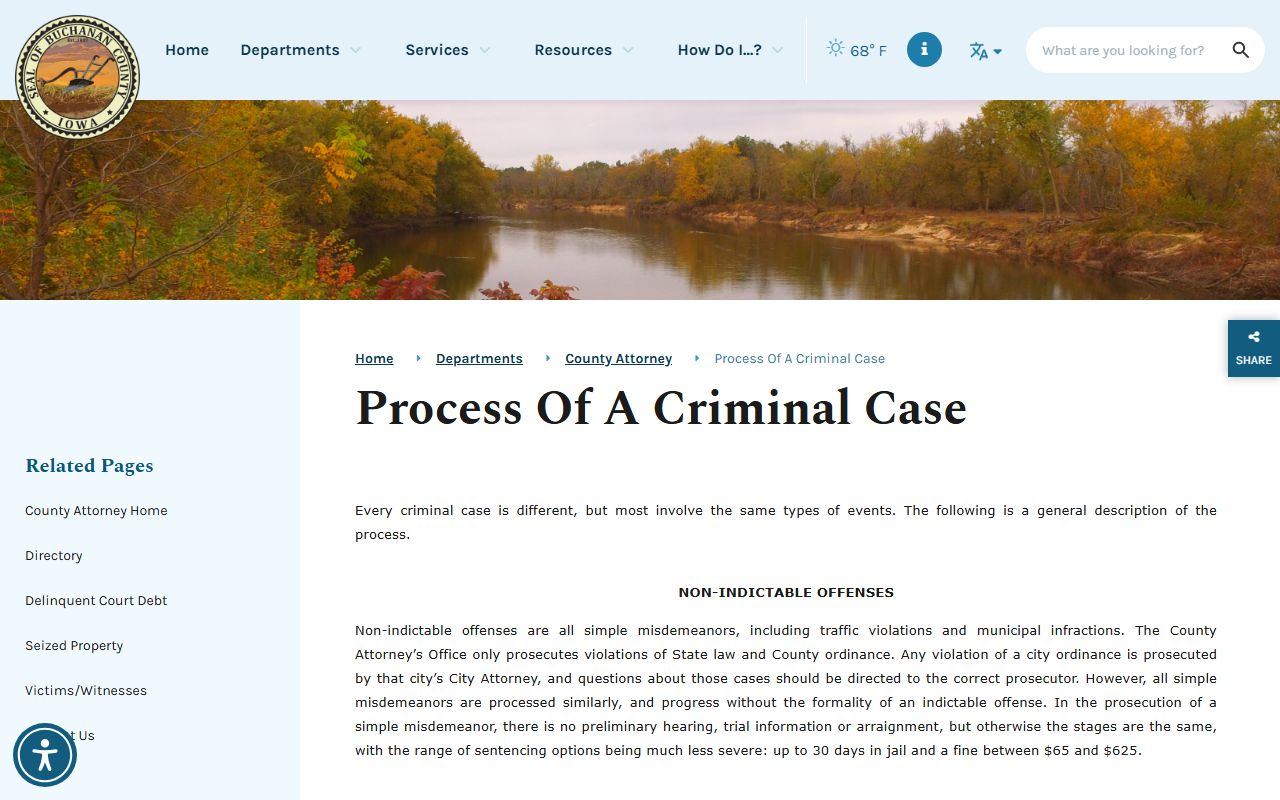
That local process page is why the court record should be read as a prosecutor-reviewed case record, not just a copy of the booking entry.
Buchanan County Charge Status
Charge status can change after arrest. The first booking entry may not match the final filed charge, and the final charge may not match the conviction, if there is one. The prosecutor can decline a case, file a different charge, amend a charge, or proceed on a Trial Information. The court docket is the place to track that change because it reflects clerk entries, hearings, orders, pleas, dismissals, and sentencing events.
| Status | What It Means |
|---|---|
| Pending | The court case or charge remains open and has not reached final disposition. |
| Amended or reduced | The filed charge was changed, often after further review, motion practice, or plea negotiation. |
| Dismissed | The charge was ended by court action or prosecutor request, subject to the exact docket entry. |
| Convicted | The charge resulted in a guilty plea, finding, or verdict as reflected in the court record. |
| Acquitted | The defendant was found not guilty on that charge. |
Bond After Buchanan County Arrest
The Buchanan County Attorney process page says the initial appearance covers charges, rights, possible consequences, appointed-counsel eligibility, no-contact orders in some cases, preliminary-hearing dates, and bail or release conditions. Official county jail pages did not publish a local bond-payment page or accepted bond methods. That means a person should confirm payment route with the jail, clerk, or court before sending money or assuming a bond can be posted in one place.
| Bond or Hold Term | How It Works |
|---|---|
| Cash bond | Money paid under court conditions to secure release and future appearance. |
| Surety bond | A bond backed through a surety arrangement where allowed by the court process. |
| Personal recognizance | Release based on a promise to appear, often with court-ordered conditions. |
| No-bond hold | Custody status where payment on a bond does not authorize release. |
| Detainer or other hold | A request or hold from another agency that can keep a person in custody after one local issue is addressed. |
Buchanan County Arrest Warrants
No official Buchanan County Sheriff active-warrant database or most-wanted page was located in the research. The strongest local warrant source is the County Attorney process page, which explains that a magistrate can decide between a summons and an arrest warrant. Iowa Courts Online can be searched for criminal and traffic cases, warrant-related docket entries, no-contact orders, missed appearances, and court events. The Sheriff's Office main line is (319) 334-2568 for law-enforcement routing, and the FAQ routes protection-order and no-contact-order questions to the Clerk of Court at (319) 334-2196.
- Arrest warrant
- A court order authorizing an arrest.
- Bench warrant
- A warrant often issued after a missed court appearance or violation.
- Search warrant
- A court order authorizing a search of a place or property, with separate access limits.
- Fugitive or hold warrant
- A warrant or hold involving another jurisdiction that can affect release.
Charges and Convictions
For Buchanan County court records after a jail arrest, a charge is not a conviction. A charge is an accusation filed in court or reflected in a case record. A conviction requires a guilty plea, finding, or verdict. The county inmate-search page and the County Attorney's public-comment policy both reinforce the presumption-of-innocence principle. That distinction should stay clear when reading a docket, jail listing, news item, or criminal-history response.
| Record Point | Charge | Conviction |
|---|---|---|
| Stage | Accusation filed or alleged after review. | Final finding, verdict, or plea on a charge. |
| Meaning | Shows what the person is accused of. | Shows the charge was proved or admitted in court. |
| Where viewed | Court docket, charging document, and sometimes jail context. | Court disposition, sentencing entries, and some criminal-history records. |
Sealed and Expunged Records
Iowa Code chapter 901C creates expungement paths for qualifying dismissed or acquitted charges and certain misdemeanor convictions. Expungement can make qualifying court records confidential from public access, but it is not a universal internet takedown and it does not automatically prove that every agency record or third-party copy disappears. Juvenile matters, sealed records, expunged cases, medical information, and active investigative materials can also be restricted under other laws.
| Record Treatment | Public View | Key Limit |
|---|---|---|
| Sealed or confidential | Hidden from ordinary public access when a law or order applies. | Some officials or agencies may still have lawful access. |
| Expunged under Iowa chapter 901C | Qualifying court records become confidential from public access. | Eligibility depends on the charge, result, timing, and statutory conditions. |
| Not restricted | May remain visible in public docket or criminal-history channels. | A public charge still must not be treated as proof of conviction unless the disposition says so. |
Buchanan County Background Records
The Iowa DPS/DCI criminal-history record-check process is separate from Iowa Courts Online. The research file documents online, mail, fax, in-person, and email request options, with no phone requests accepted and a $15 fee per last name. Criminal-history responses can serve a different purpose than a court docket because they focus on state criminal-history data rather than the full court case index. Iowa Code chapter 692 also requires warnings that an arrest without disposition is not an indication of guilt.
Important: Do not use casual court or jail lookups for FCRA-covered screening decisions.
Buchanan County Court Documents
Public docket access does not mean every case document can be downloaded from home. Iowa Courts research states that public case documents are viewed at a public access terminal at the courthouse in the county where the case was filed. For Buchanan County court records after a jail arrest, that points to the courthouse records environment in Independence, not to a sheriff roster screen. Portal technical problems can be directed to the Iowa Courts help desk at support@iowacourts.gov or 1-800-831-1396, Monday-Friday 7:00 am-5:00 pm except holidays. Case-specific questions should go through the clerk or court process, not the technical help desk.
Note: A court docket can show a case exists, while document access and confidential-record rules decide what can actually be viewed.